Lupus Window Tint Exemption: Get Legal Dark Tint Same Day — No Clinic Visit, No Sun Flare Risk
 by Nida Hammad
 Last updated:
Medically reviewed by:
Dr. Matthew Reynolds, MD


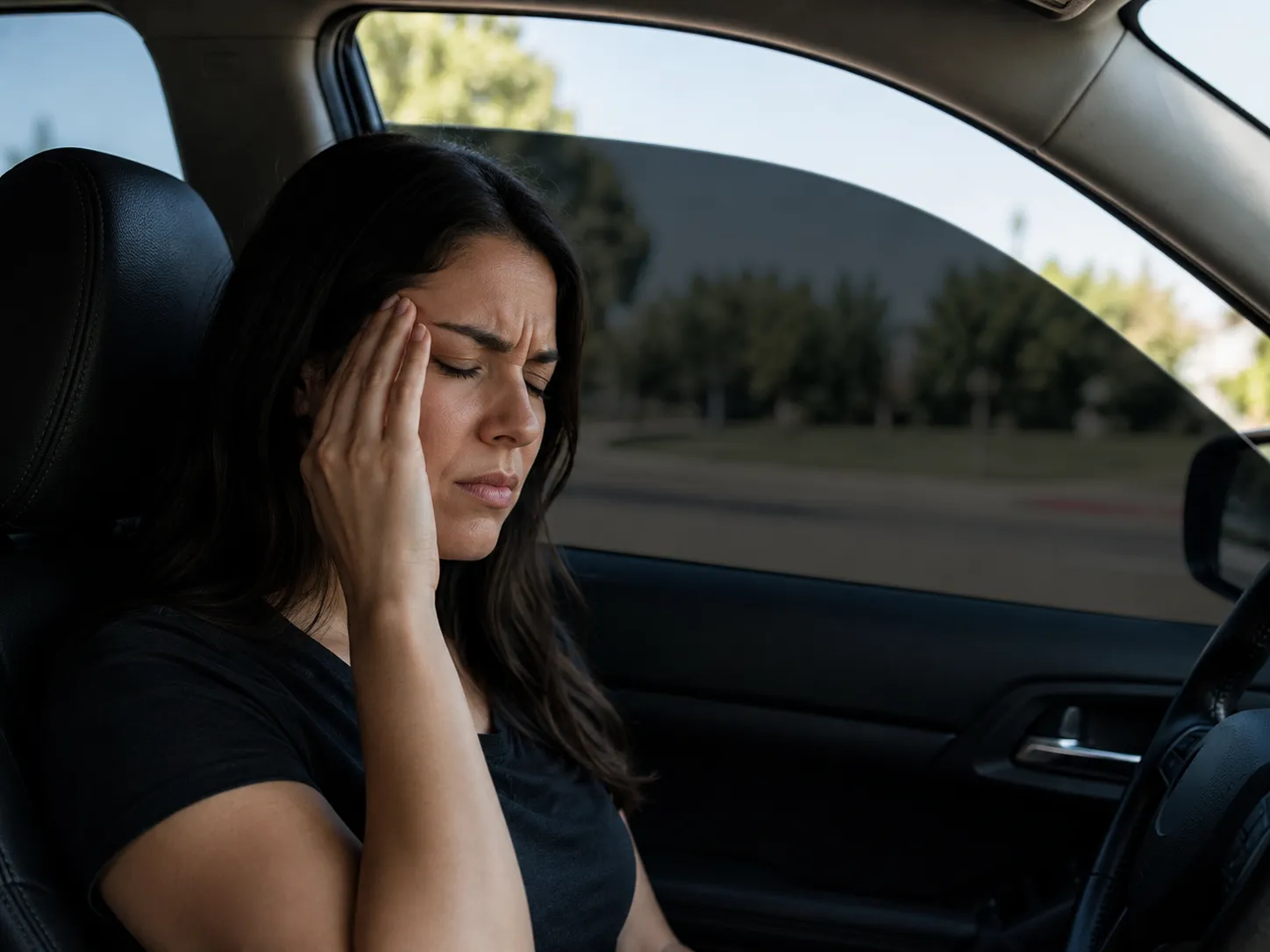
If you have lupus, sunlight is not just uncomfortable — it is a documented medical trigger. UV exposure is one of the most consistently confirmed causes of lupus flares, and the side windows of a standard car block very little of the UVA radiation that drives those flares. A lupus window tint exemption is the legal tool that lets you install protective window film dark enough to actually reduce that UV load during the hours you spend in your vehicle.
This guide covers who qualifies, what the documentation must include, how every state handles the process, and how to get your exemption done correctly the first time.
The average commuter spends roughly 50 minutes per day in a vehicle. For a lupus patient, every one of those minutes in a car with standard side windows is a minute of UVA exposure that bypasses sunscreen, clothing, and every other sun protection strategy. A properly installed tinted window is the only sun protection measure that stays constant for the entire drive, requires no daily reapplication, and works regardless of weather or trip duration.
Consider the math. A lupus patient who commutes 25 minutes each way, five days a week, accumulates about 200 hours of vehicle UVA exposure per year through standard side glass. At 63% UVA transmission through standard glass, that is the equivalent of 126 hours of full UVA exposure annually from commuting alone — before any other outdoor exposure. Quality ceramic tint film at an exemption-authorized VLT reduces that number by 99%. That is the difference a lupus window tint exemption makes in practice, not just on paper.
If you want to start now, TintedMD’s same-day evaluation connects you with a licensed physician in your state.
Why Lupus Qualifies for a Window Tint Exemption
Lupus photosensitivity is not simply discomfort in bright light. It is a documented immune response to ultraviolet radiation that can trigger skin inflammation, joint pain, and whole-body flares. According to a Frontiers in Immunology review on lupus and UV photosensitivity, the reported frequency of photosensitivity reaches up to 93% in lupus patients depending on disease subtype. UV light causes skin cells to release proteins that the lupus immune system is already attacking, which is why sun exposure does not just cause rashes — it can trigger systemic disease activity.
Standard car side windows block most UVB radiation but allow roughly 29% of UVA to pass through. A 2024 study published in the Archives of Dermatological Research found that front windshields blocked 96% of UVA rays, while driver’s side windows blocked only 71%, leaving roughly 29% of UVA reaching the driver. UVA is the longer-wavelength radiation that penetrates deeper into the skin, is present year-round even on cloudy days, and is the primary UV driver of lupus photosensitivity reactions. Ceramic tint film can block 99% or more of UV radiation, providing significantly stronger protection than standard glass.
According to CDC lupus prevalence data, an estimated 204,000 Americans have systemic lupus erythematosus, with 9 out of every 10 being women. Women of childbearing age between 15 and 44 have the highest risk of developing SLE. These are people who drive daily with meaningful and preventable UV exposure coming through their side windows.
This is the clinical basis for the exemption across all states that offer one. The connection between lupus and UV exposure is so well established that photosensitive rash is an original diagnostic criterion for lupus. States recognize this, which is why lupus appears on the qualifying condition list in virtually every state that has a medical tint exemption program.
Does Lupus Qualify in Your State?
Lupus qualifies for a window tint exemption in every state that offers a medical tint exemption. Here is what each category of state recognizes:
- Explicit lupus listing: Florida, California, New York, Georgia, Massachusetts, and others name lupus directly in their qualifying condition lists or state forms.
- Photosensitivity disorder language: Most other states qualify lupus under broad language covering conditions causing severe photosensitivity requiring UV protection.
- Physician discretion states: Oklahoma, Missouri, and Arkansas allow any physician to certify any debilitating condition. Lupus clearly qualifies.
- No exemption: Colorado and Kansas. No document creates a legal exception in either state.
- No restrictions: Michigan. No VLT limits on non-windshield windows. No exemption needed.
All major forms of lupus qualify: systemic lupus erythematosus (SLE), cutaneous lupus (CLE), subacute cutaneous lupus (SCLE), and discoid lupus (DLE). The photosensitivity connection is clinically documented for all of them. Florida’s program is the most favorable for lupus patients because it specifically names lupus and issues a non-expiring exemption certificate. For every other state, TintedMD confirms your state’s current requirements before beginning the evaluation.
What Your Medical Documentation Must Include
Most lupus window tint exemption rejections come from documentation errors, not from the condition failing to qualify. Here is exactly what must be in the physician letter.
Required Elements in Every Lupus Tint Exemption Letter
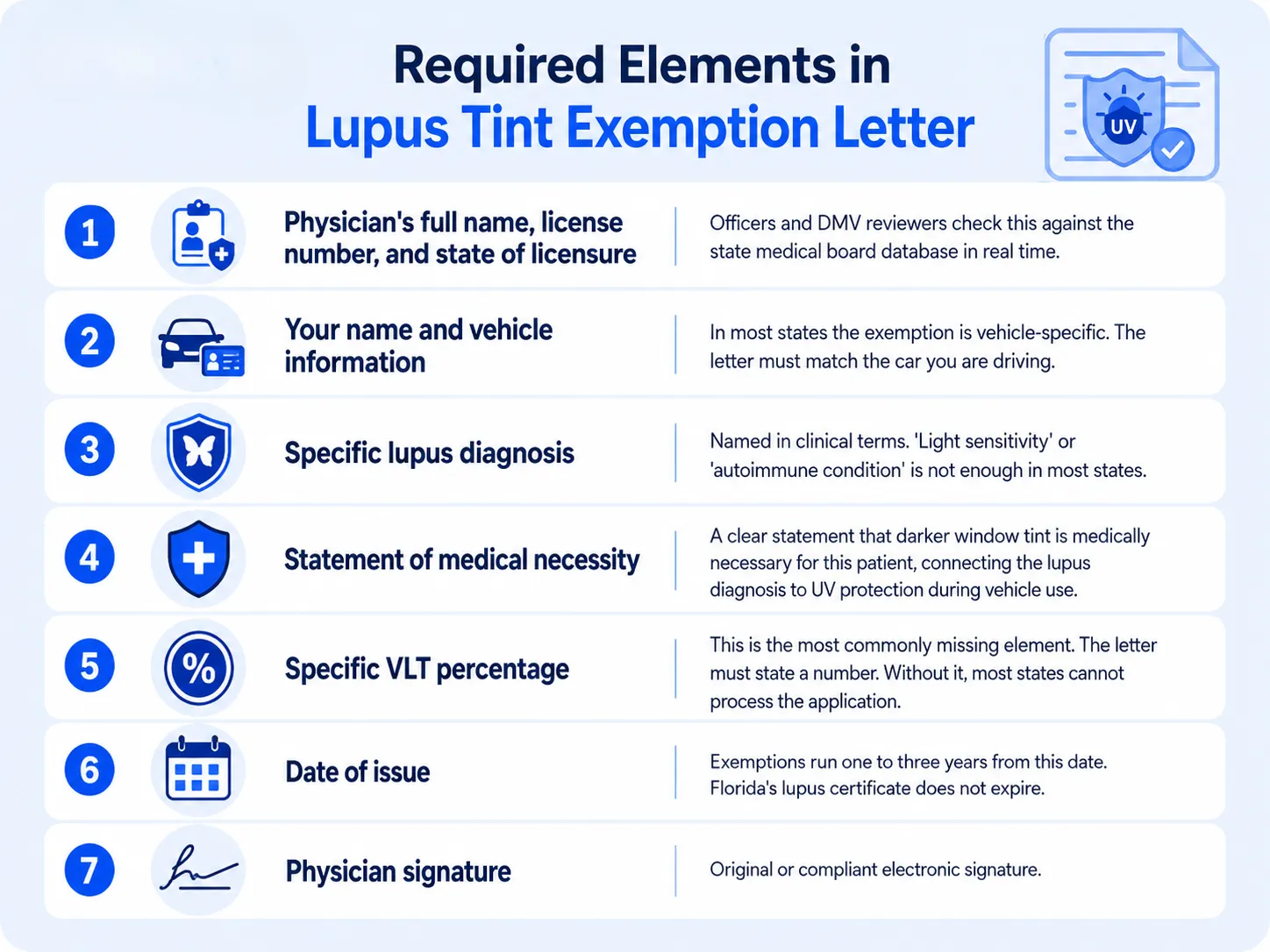
- Physician’s full name, license number, and state of licensure: Officers and DMV reviewers check this against the state medical board database in real time.
- Your name and vehicle information: In most states the exemption is vehicle-specific. The letter must match the car you are driving.
- Specific lupus diagnosis: Named in clinical terms. “Light sensitivity” or “autoimmune condition” is not enough in most states.
- Statement of medical necessity: A clear statement that darker window tint is medically necessary for this patient, connecting the lupus diagnosis to UV protection during vehicle use.
- Specific VLT percentage: This is the most commonly missing element. The letter must state a number. Without it, most states cannot process the application.
- Date of issue: Exemptions run one to three years from this date. Florida’s lupus certificate does not expire.
- Physician signature: Original or compliant electronic signature.
TintedMD physicians complete these letters in the correct format for every qualifying state. Your treating rheumatologist may know your lupus deeply but has almost certainly never written a photosensitivity tint exemption letter before. The result is a letter that is medically sound but missing the VLT field or formatted for the wrong form. TintedMD closes that gap.
The VLT percentage is the element most commonly omitted by physicians writing their first tint exemption letter. A physician expert in managing lupus disease activity may simply not know that the DMV requires a specific number on the letter. “Darker tint is medically necessary” without specifying a percentage gets rejected in most states. TintedMD physicians know this because they have completed these letters for thousands of lupus patients across all qualifying states.
How to Get a Lupus Window Tint Exemption: Step by Step
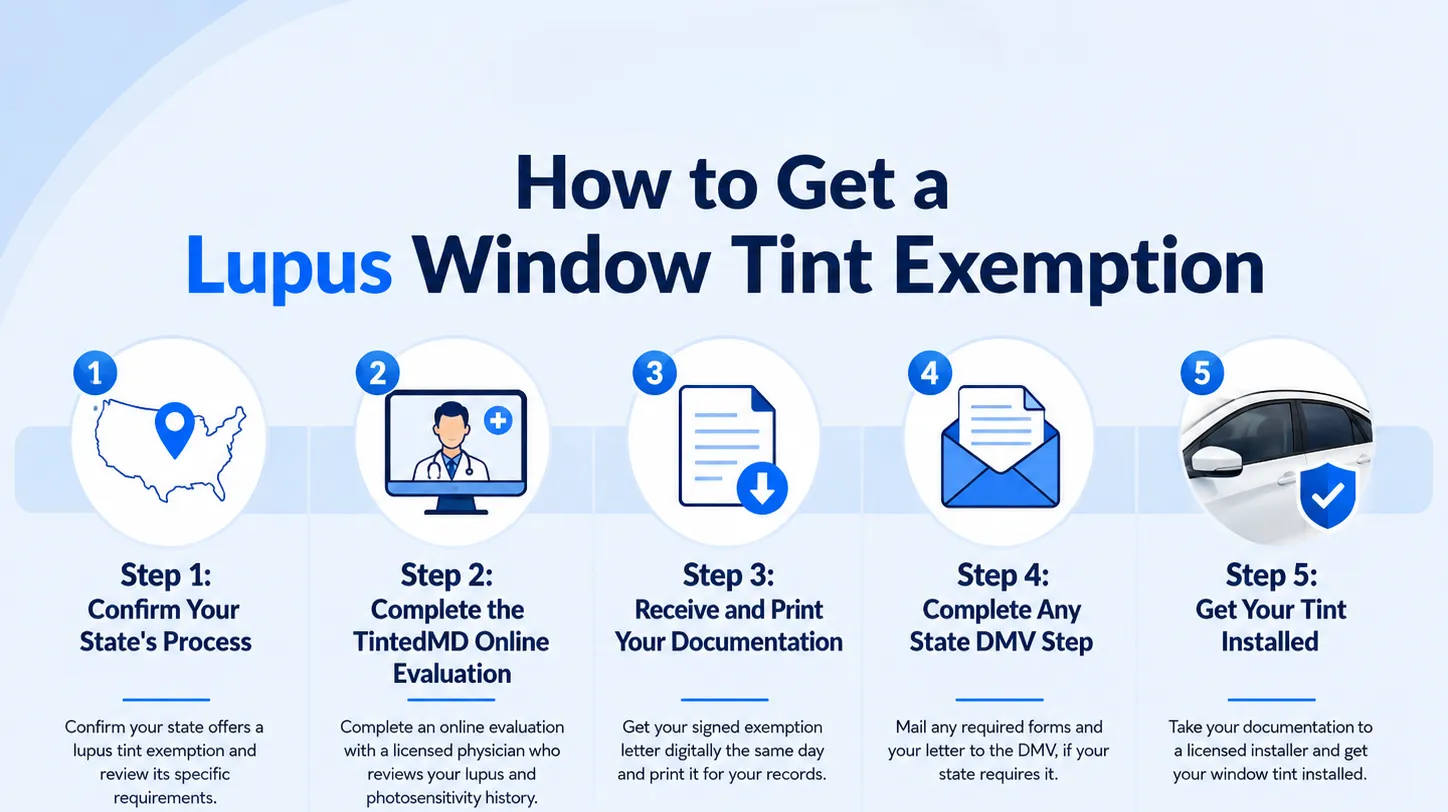
Step 1: Confirm Your State’s Process
Before anything else, confirm that your state offers a lupus window tint exemption and check whether it requires only a physician letter or also a state form submitted by mail. TintedMD’s state eligibility tool confirms current requirements before you begin.
Step 2: Complete the TintedMD Online Evaluation
The evaluation happens entirely online. A licensed physician in your state reviews your lupus diagnosis and photosensitivity history through a telehealth consultation. No office visit, no travel. The physician completes your state-specific exemption documentation the same day.
Step 3: Receive and Print Your Documentation
Your signed lupus window tint exemption letter is delivered digitally same-day. Print it and keep the original in your glovebox. Review it before printing to confirm your name matches your vehicle registration, your lupus diagnosis is named specifically, a VLT percentage is stated, and your physician’s license number is present.
Step 4: Complete Any State DMV Step
Some states require a follow-up mail submission. Key examples:
- California: Download Form REG 256A, attach your physician letter, mail to CA DMV. No in-person visit required.
- Florida: Mail Form HSMV 83390 with physician certification to FLHSMV. $6.45 fee. Non-expiring certificate issued for lupus.
- New York: Mail completed Form MV-80W endorsed by your physician to NY DMV.
- Texas: Physician letter on official letterhead submitted to Texas DPS. Carry the original. No copies accepted.
- Most other states: Physician letter alone, carried in the vehicle. No DMV submission needed.
Step 5: Get Your Tint Installed
Take your documentation to a licensed installer. Show them the letter and confirm the authorized VLT. Ask for a ceramic or carbon film with 99% UV rejection. Get a post-installation VLT measurement receipt and keep it in the glovebox alongside your lupus exemption letter.
All 50 States: Lupus Window Tint Exemption at a Glance
Below is the full state reference for every state and Washington DC. Always confirm current requirements with your state DMV before applying.
| State | Process and Key Notes |
|---|---|
| Alabama | Mail-in to ALEA. Numbered decal issued and displayed on windshield. Original letter recommended. |
| Alaska | Physician letter in vehicle. Annual renewal required. No DMV submission needed. |
| Arizona | Physician letter in vehicle. No DMV form or submission required. |
| Arkansas | Mail-in to Arkansas State Police. Certificate issued valid for 3 years. |
| California | Form REG 256A + physician letter mailed to CA DMV. No in-person visit. |
| Colorado | NO EXEMPTION AVAILABLE under any condition. |
| Connecticut | Validated DMV form submitted by mail. Minimum 20% VLT. |
| Delaware | Form MV495 obtained in person at Delaware DMV only. TintedMD handles physician letter. |
| Florida | Form HSMV 83390 mailed to FLHSMV. Non-expiring certificate for lupus. $6.45 fee. |
| Georgia | Georgia DPS application by mail. $10 fee. Minimum 23% VLT. |
| Hawaii | No formal exemption statute. No statutory protection. |
| Idaho | Mail-in to Idaho Transportation Dept. Copy generally accepted. |
| Illinois | Mail-in to Illinois Secretary of State. Certificate issued. |
| Indiana | Mail-in to Indiana BMV. Original recommended. |
| Iowa | Mail-in to Iowa DOT. Copy accepted. |
| Kansas | NO EXEMPTION AVAILABLE under any condition. |
| Kentucky | Mail-in to Kentucky Transportation Cabinet. Original recommended. |
| Louisiana | Mail-in to Louisiana OMV. Original preferred. |
| Maine | Mail-in to Maine BMV. Copy accepted. |
| Maryland | Mail-in to Maryland MVA. Pre-approval required before installation. Original certificate. |
| Massachusetts | Mail-in to Massachusetts RMV. Original recommended. |
| Michigan | No VLT restrictions on non-windshield windows. No exemption needed. |
| Minnesota | Physician letter or notarized affidavit in vehicle. No DMV submission. |
| Mississippi | Mail-in to Mississippi DPS. Original preferred. |
| Missouri | Mail-in to Missouri DOR. Copy accepted. |
| Montana | Signed physician affidavit in vehicle. Updated every 2 years. Original required. |
| Nebraska | Mail-in to Nebraska DMV. Original recommended. |
| Nevada | Mail-in to Nevada DMV. Copy accepted. |
| New Hampshire | Mail-in to NH DMV. Copy accepted. |
| New Jersey | Mail-in to NJ MVC. Renewed every 4 years. Original recommended. |
| New Mexico | Physician letter in vehicle. No DMV submission required. |
| New York | Form MV-80W endorsed by physician, mailed to NY DMV. Original form required. |
| North Carolina | Mail-in pre-approval to NC DMV before installation. Original certificate required. |
| North Dakota | Mail-in to ND DOT. Copy accepted. |
| Ohio | Mail-in to Ohio BMV. Original recommended. |
| Oklahoma | Physician letter in vehicle. Broad physician discretion. Original strongly recommended. |
| Oregon | Form 735-6513 completed by physician and mailed to Oregon DMV. Original required. |
| Pennsylvania | UV-blocking clear film only (not tinted). PennDOT Medical Unit by mail or phone. |
| Rhode Island | Original affidavit mailed to RI DMV. Decal issued and displayed on vehicle. |
| South Carolina | Mail-in to SC DMV. Original preferred. |
| South Dakota | Mail-in to medical review board. Original required. |
| Tennessee | Physician letter in vehicle. No standard DMV form. Original strongly recommended. |
| Texas | Physician letter on letterhead mailed to Texas DPS. Original only. No copies. |
| Utah | Mail-in to Utah Driver License Division. Copy accepted. |
| Vermont | Mail-in to Vermont DMV. Copy accepted. |
| Virginia | Mail-in to Virginia DMV. Decal issued and displayed. Letter in glovebox. |
| Washington | Physician letter or notarized affidavit in vehicle. No DMV submission. |
| Washington DC | Physician letter on official letterhead in vehicle. No separate form required. |
| West Virginia | Mail-in to WV DMV. Decal issued and displayed. Letter in glovebox. |
| Wisconsin | Form MV2780 with physician signature mailed to Wisconsin DOT. Original recommended. |
| Wyoming | Mail-in to Wyoming DOT. Copy accepted. |
What Invalidates Your Exemption at a Traffic Stop
Getting a lupus window tint exemption is only half the job. Keeping it valid at a stop is the other half. Here are the five most common reasons officers still issue citations even when the driver has a letter:
- Expired letter: An officer who checks the date on an expired exemption will cite you even if your condition is ongoing. Renew 60 days before expiration.
- No VLT percentage stated: Without a specific number, the exemption cannot be verified against the meter reading.
- Physician licensed in the wrong state: The certifying physician must hold an active license in the state where the exemption applies.
- Wrong vehicle on the letter: In most states, the exemption is vehicle-specific. A letter for a different car does not cover your current one.
- Photocopy in Texas: Texas officers require the original physician letter. A photocopy is not accepted.
TintedMD addresses all five of these at the documentation stage. If your letter is rejected by a qualified reviewer for any stated reason, TintedMD will issue a corrected letter or refund the evaluation cost under the money-back guarantee. Start your evaluation at TintedMD.com.
Conclusion
Lupus is one of the strongest qualifying conditions for a window tint exemption in the United States. The clinical evidence is clear, the legal recognition is broad, and the process is accessible in 48 states plus DC. The barrier for most patients is not qualification — it is documentation. A physician letter missing a VLT percentage, signed by an out-of-state physician, or formatted incorrectly for your state will fail regardless of how legitimate the underlying medical need is.
The exemption is worth getting right the first time. A rejected application adds weeks to your timeline, leaves you driving with either inadequate UV protection or dark tint you cannot legally defend, and requires starting the documentation process again.
TintedMD closes that gap. Licensed physicians in your state, experienced in completing medical window tint for lupus documentation, produce the right letter the first time. More than 100,000 patients have been helped through the platform. Same-day delivery. Money-back guarantee.
If you have lupus and spend time in a vehicle, you should have a window tint exemption. The UV exposure from daily driving is real, preventable, and now straightforward to protect against. Start your TintedMD evaluation today and have your documentation in hand same-day.
Frequently Asked Questions
Does lupus qualify for a window tint exemption in every state?
Lupus qualifies for a window tint exemption in every state that offers a medical tint exemption. Colorado and Kansas have no exemption program at all. Hawaii has no formal statutory process. Michigan has no VLT restrictions. Every other state recognizes lupus either explicitly by name or through photosensitivity or autoimmune condition language in its qualifying criteria.
How long does the process take?
Through TintedMD, your physician letter is ready the same day you apply. In states where the physician letter alone is sufficient — such as Texas, Washington, and Tennessee — you can be driving with legal lupus sun-protective windows the same day as your evaluation plus installer time. In states requiring DMV mail-in submission, add two to six weeks for state processing.
What makes Florida's program special for lupus patients?
Florida is the only state that issues non-expiring exemption certificates specifically for lupus as a named autoimmune condition. Once your Florida lupus window tint exemption certificate is issued, you do not need to renew it as long as you keep the same vehicle. Submit Form HSMV 83390 with your physician certification by mail with a $6.45 fee.
Can I use my rheumatologist's letter instead?
Your rheumatologist's records are valuable supporting documentation, but they rarely include all the required elements for a state DMV review — particularly the specific VLT percentage. The most effective approach is to use TintedMD for the exemption letter, which is formatted correctly for your state, and use your rheumatologist's records as supporting clinical evidence of your diagnosis and photosensitivity history.
What if I'm pulled over before my exemption is processed?
If you are in a state that requires DMV mail-in submission and your application is pending, keep a copy of your TintedMD physician letter in the vehicle. The letter demonstrates medical necessity even before the state certificate is issued. In states where the physician letter alone is the exemption document, you are fully covered as soon as the letter is delivered.
Does the exemption transfer if I sell my car?
In most states, no. The lupus window tint exemption is tied to the specific vehicle, not the driver. If you sell the car, the new owner needs their own exemption or must remove the tint. Florida's non-expiring certificate is also vehicle-specific. If you buy a new car, start a new evaluation for the new vehicle as soon as possible.
How dark can I tint my windows with a lupus exemption?
Your physician recommends a specific VLT based on your photosensitivity level and your state's minimum VLT floor for medical exemptions. Most physicians recommend 20% to 35% VLT for lupus patients on front side windows. No state allows completely opaque front windows even with a photosensitivity tint exemption. VLT and UV rejection are separate measurements — a 35% VLT ceramic film can block 99% of UV. Ask your installer for the UV rejection percentage, not just the VLT.

Meet the author
Nida Hammad
I am a professional writer with over five years of experience creating clear, engaging, and well-researched content. I specialize in medical window tint exemptions and state compliance topics, helping readers understand tint laws and exemption requirements in simple, easy-to-follow language. Currently, I write for TintedMD, where I focus on producing accurate, trustworthy guides to help drivers navigate the medical tint exemption process with confidence.
Get Your Medical Tint Exemption Online in Minutes
Check Your Eligibility