
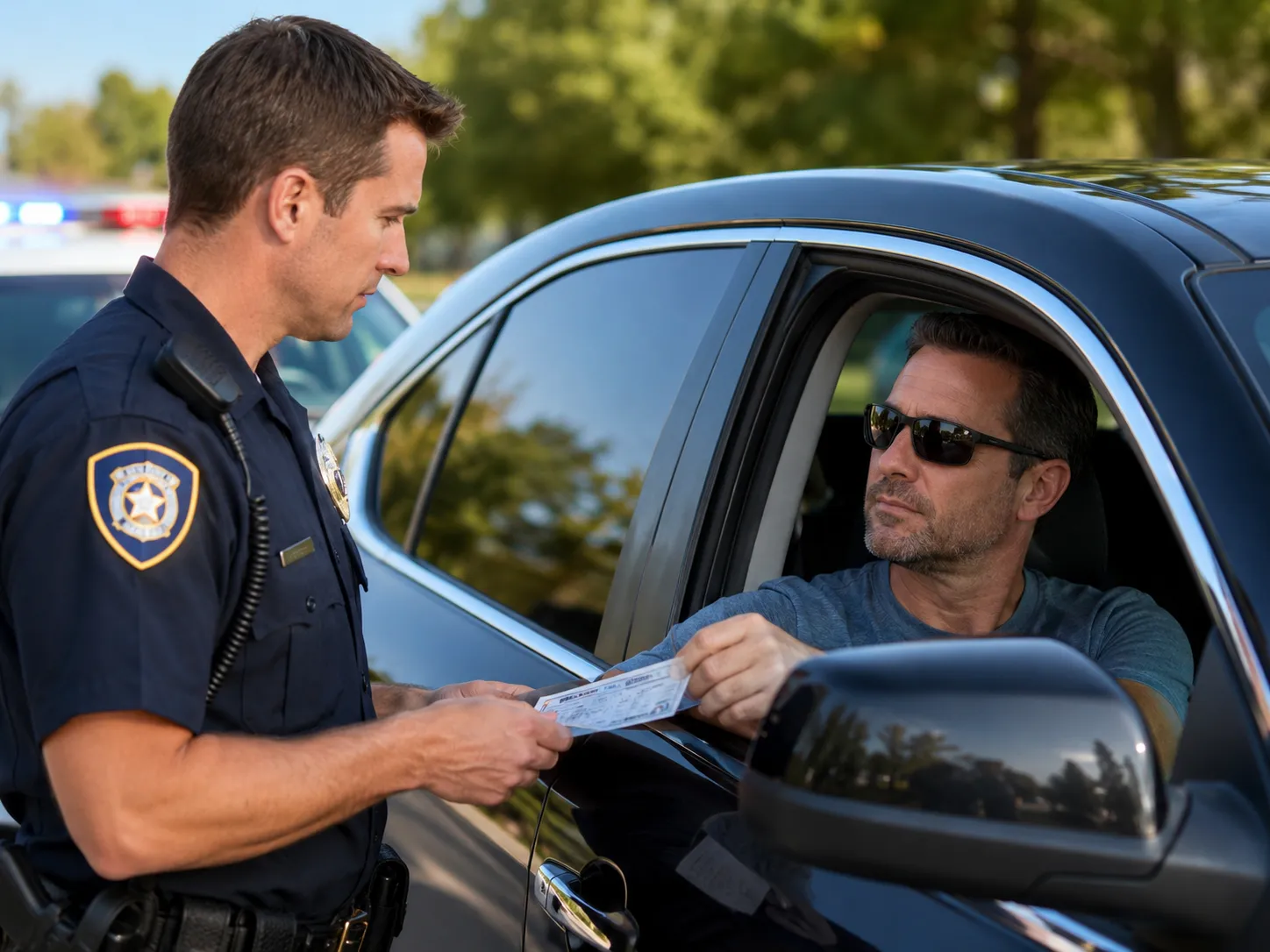
Medical Tint Exemption Traffic Stop: Exactly What to Show Police to Drive Away Free
 by Nida Hammad
 Last updated:
Medically reviewed by:
Dr. Matthew Reynolds, MD


Most medical window tint exemption traffic stops end in under two minutes when you have the right document ready. The officer sees dark tint, stops the vehicle, and checks for a violation. Your state-approved exemption certificate ends that check on the spot. The five most common reasons a stop turns into a ticket are not having the certificate in the car, showing a doctor’s note instead of the official state document, the certificate not matching the vehicle registration, an expired exemption, and not telling the officer upfront. None of these is a permanent problem — each is fixable before your next drive.
What Counts as a Medical Tint Exemption at a Traffic Stop
A medical tint exemption is an official document from your state’s motor vehicle department. It lets you use darker window tint than normal law allows. You can get it when a licensed doctor says your medical condition makes sunlight harmful for you.
Some common medical conditions that may qualify include lupus, albinism, xeroderma pigmentosum, photophobia, dermatomyositis, and strong sensitivity to sunlight caused by certain medicines. Studies published on PubMed show that people with conditions like lupus can benefit from darker car windows because sunlight and UVA rays can still pass through regular glass and cause serious health problems.
A medical tint exemption is different from a simple doctor’s note. It is an official document approved by the state and connected to your vehicle registration. In many states, you must keep this document inside your car at all times.
Why a Medical Tint Exemption Traffic Stop Still Happens
Police officers cannot tell if you have a medical tint exemption just by looking at your car from outside. They only see dark window tint, and their job is to enforce tint laws. That is why they may stop your vehicle.
According to the New York DMV, your windshield and front side windows cannot block more than 30% of outside light, meaning at least 70% of light must pass through. The same rule applies to the rear window unless your vehicle has outside rear-view mirrors on both sides. If your windows do not comply, it is against the law, and your car will fail its yearly safety inspection.
If you have a medical condition that makes you sensitive to sunlight, you can apply for a special exemption through a medical window tint exemption. However, you must fill out an official form and get approval from the DMV. If the police pull you over for dark windows, you will need to show them your official paperwork.
What to Do During a Medical Tint Exemption Traffic Stop
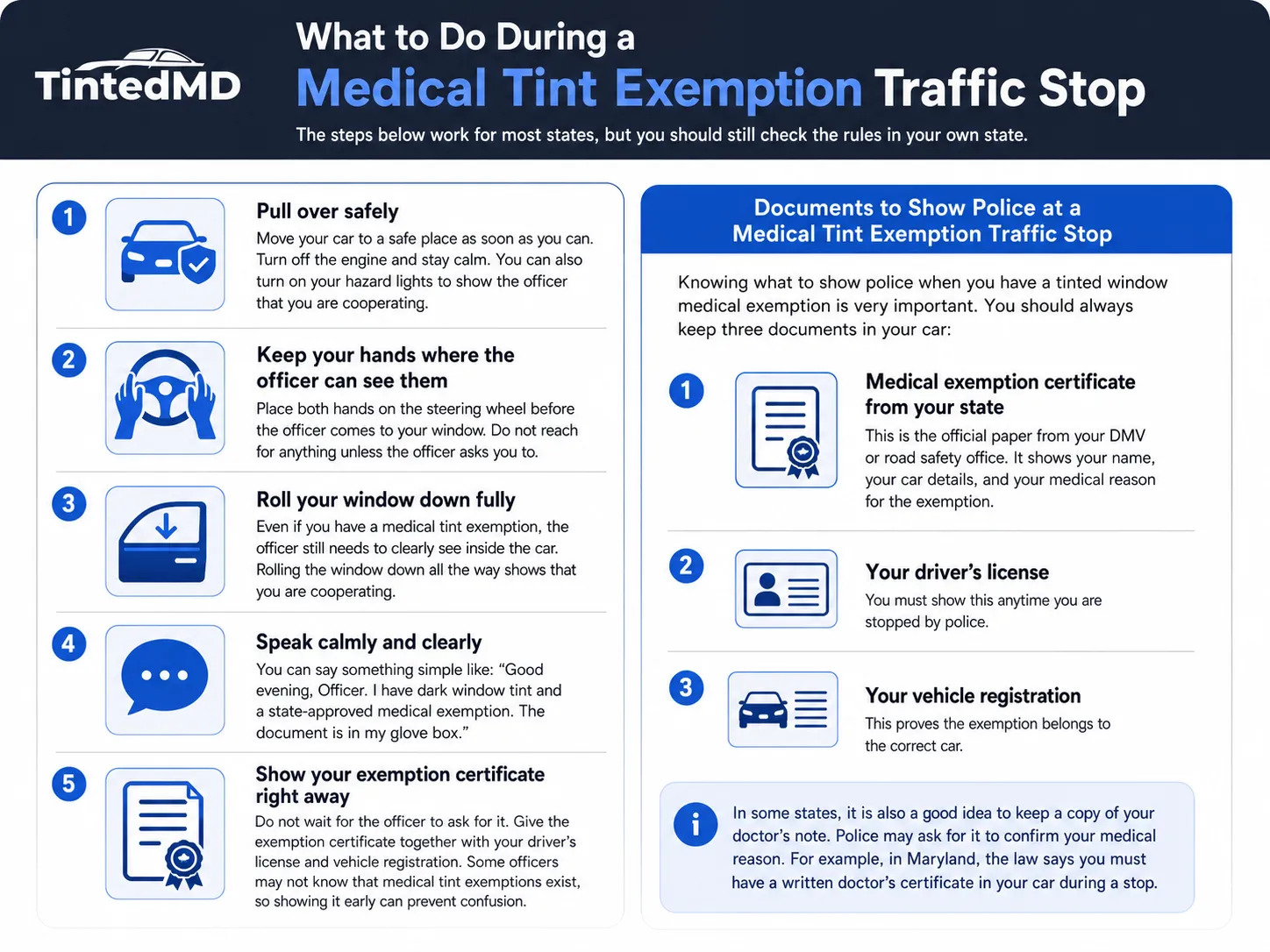
The steps below work for most states, but you should still check the rules in your own state.
Step 1: Pull over safely
Move your car to a safe place as soon as you can. Turn off the engine and stay calm. You can also turn on your hazard lights to show the officer that you are cooperating.
Step 2: Keep your hands where the officer can see them
Place both hands on the steering wheel before the officer comes to your window. Do not reach for anything unless the officer asks you to.
Step 3: Roll your window down fully
Even if you have a medical tint exemption, the officer still needs to clearly see inside the car. Rolling the window down all the way shows that you are cooperating.
Step 4: Speak calmly and clearly
You can say something simple like: “Good evening, Officer. I have dark window tint and a state-approved medical exemption. The document is in my glove box.”
Step 5: Show your exemption certificate right away
Do not wait for the officer to ask for it. Give the exemption certificate together with your driver’s license and vehicle registration. Some officers may not know that medical tint exemptions exist, so showing it early can prevent confusion.
Documents to Show Police at a Medical Tint Exemption Traffic Stop
Knowing what to show police when you have a tinted window medical exemption is very important. You should always keep three documents in your car:
1. Medical exemption certificate from your state: This is the official paper from your DMV or road safety office. It shows your name, your car details, and your medical reason for the exemption.
2. Your driver’s license: You must show this anytime you are stopped by police.
3. Your vehicle registration: This proves the exemption belongs to the correct car.
In some states, it is also a good idea to keep a copy of your doctor’s note. Police may ask for it to confirm your medical reason. For example, in Maryland, the law says you must have a written doctor’s certificate in your car during a stop.
How to Explain Your Medical Tint Exemption During a Traffic Stop
Many police officers may not see a medical window tint exemption very often during a traffic stop. If the officer looks unsure, stay calm and be patient. Do not argue.
You can say: “I understand you may not see this often. This certificate was given by the state DMV and it is linked to this vehicle registration.”
Do not tell the officer they are wrong, and do not raise your voice. If they ask questions, answer in a simple and clear way.
Being calm and cooperative can help your situation. If the officer still gives you a ticket, accept it. You can challenge it in court later and show your exemption certificate as proof. In many states, tickets are canceled when valid documents are shown.
If you need doctor-approved documentation that holds up at a traffic stop or in court, get your medical tint exemption through TintedMD’s licensed provider evaluation, which is fully online, HIPAA-compliant, and approved in 24 to 48 hours.
What the Law Says About a Medical Tint Exemption Traffic Stop
Laws vary by state, but most share one common rule: you must keep your medical exemption certificate inside the vehicle at all times. According to a 2024 study published in the Journal of the American Academy of Dermatology, state governments set their own tinting limits and exemption policies, creating significant variation across the country with real implications for patients who need sun protection for medical reasons.
In Florida, the law is straightforward. Florida issues medical exemption certificates to people with conditions such as lupus, autoimmune diseases, or other medical conditions that require limited exposure to light. The certificate is non-transferable and must include the vehicle’s make, model, year, and VIN number, along with the registered owner’s name. It becomes void if the vehicle is sold or transferred.
In New York, drivers must fill out Form MV-80W. A doctor, physician assistant, or nurse must sign it. If you do not have the approved sticker or certificate in your car, the officer can still give you a ticket, even if your medical condition is real.
This is why correct paperwork is so important. When your documents are complete, official, and easy to show, dealing with police during a tint exemption check usually goes more smoothly.
What Happens If You Are Ticketed During a Medical Tint Exemption Traffic Stop
Even if you have a valid exemption, some police officers may still give you a ticket. This can happen when:
- The officer cannot check your exemption right away
- The certificate looks new or unfamiliar to them
- State rules say the officer must still write a ticket and let the court decide
If this happens, stay calm. Accept the ticket politely. Then collect your documents and go to your court date to explain your case.
Bring your original state exemption certificate, your doctor’s note, and any medical records that show your condition.
In most states, courts will cancel the ticket if you show proper proof. The most important thing is that your documents must be real, official, and issued through your state and a licensed medical provider.
How to Prepare for a Medical Tint Exemption Traffic Stop
If you have a medical condition that qualifies but do not yet have a state-approved exemption, it is important to act early. This can help you avoid problems during future traffic stops.
In most states, the process has three steps. First, a licensed doctor checks your condition. Second, you send the required form to your state DMV or highway safety office. Third, you receive your official certificate and keep it in your car.
In many places, you do not need to visit a clinic in person anymore. Telehealth makes the process faster and easier. For example, Florida allows online doctor visits with licensed providers to be used when applying for a medical tint exemption.
Conclusion
A traffic stop is much easier when you are prepared. Always keep your state-issued exemption certificate in your glove box.
When you are stopped, stay calm. Greet the officer politely and show your documents right away. Be cooperative the whole time.
Even if you still get a ticket, your valid papers can help you win in court. The right documents, used correctly, can turn a stressful stop into a quick and simple one.
Do not wait until you are pulled over to get ready. If you have a medical condition that qualifies, the first step is to get your official paperwork as soon as possible.
If you are ready to move forward, start your online evaluation with TintedMD today and get your state-compliant exemption documentation in as little as 24 hours. The process is fully online, HIPAA-compliant, and backed by licensed medical providers.
Frequently Asked Questions
What should I say if police stop me for dark window tint?
Tell the officer right away that you have a state-approved medical tint exemption. Then give them your exemption certificate, driver's license, and vehicle registration together. Stay calm, polite, and cooperative during the stop.
Does a doctor's note work as a medical tint exemption?
No. A doctor's note alone is usually not enough. Most states require an official exemption certificate from the DMV or highway safety office. The document must be signed by a licensed medical provider and connected to your vehicle registration.
Can I still get a ticket if I have a valid exemption?
Yes. If the certificate is not in your car during the stop, the officer may still give you a ticket. Sometimes officers also write tickets even when you have the certificate. You can fight the ticket in court by showing your documents.
Can I use my medical tint exemption in other states?
Usually no. Many states do not accept exemptions from another state. For example, California requires its own application. If you travel often, check the laws in each state and keep a copy of your home state certificate with you.
How can I check if my exemption is still valid?
Look at the expiration date on your certificate. In New Hampshire, exemptions last two years. In North Carolina, they last between two and five years. In Florida, exemptions do not expire, but they become invalid if the car is sold. If your exemption has expired, you must apply again.
What medical conditions can qualify for a tint exemption?
Common conditions include lupus, albinism, photophobia, porphyria, dermatomyositis, xeroderma pigmentosum, and strong sunlight sensitivity caused by medicines. Some states also allow other conditions if a licensed doctor confirms the need for darker tint.
What if the officer thinks my exemption certificate looks fake or unofficial?
Stay calm and do not argue. If the officer gives you a ticket, accept it politely. Later, bring your exemption certificate, doctor's documents, and other medical records to court. In many cases, the court will remove the ticket when you show valid state-approved documents.

Meet the author
Nida Hammad
I am a professional writer with over five years of experience creating clear, engaging, and well-researched content. I specialize in medical window tint exemptions and state compliance topics, helping readers understand tint laws and exemption requirements in simple, easy-to-follow language. Currently, I write for TintedMD, where I focus on producing accurate, trustworthy guides to help drivers navigate the medical tint exemption process with confidence.
Get Your Medical Tint Exemption Online in Minutes
Check Your Eligibility